Viktor disabled and under tow
The Good ShepherdViktor disabled and under tow is the condition reported after Cadena signals that Viktor has been hit: the engine-room is flooded, all power is lost, other compartments are leaking, and the ship is already listing and down by the stern. The damage sharply narrows what Viktor can do, but does not make the ship immediately helpless. Its crew is shoring up bulkheads, has improvised a radio circuit from a jury battery, and is preparing to move under tow while retaining some control by hand steering. The state is therefore both a physical emergency and a test of how much order and agency the damaged ship can preserve.
The report and its urgency
Before receiving confirmation, Krause tries to reach Viktor by T.B.S. Viktor is about ten miles away, perhaps farther, and does not answer. Krause considers that the distance may prevent reception, or that the ship’s crew may be too occupied to reply, but neither possibility resolves the silence. He waits for even a brief word from the familiar English voice. Meanwhile, the Commodore directs a signal lamp at Keeling. The conditions are almost too dark for a Morse message to be safe, making the decision to transmit itself an indication of urgency.
The signal from Cadena supplies the fact the unanswered call could not: Viktor has been hit. Its concise report changes the situation from uncertain contact to confirmed damage, and Krause’s hesitation ends. The report does not specify the weapon or describe the moment of impact; what follows is an account of the ship’s condition and the work under way to keep it afloat and recoverable.
Damage, flooding, and immediate survival
Viktor’s engine-room has been struck and flooded, with all power lost. The loss disables the ship’s normal propulsion and electrical power, but does not prevent its crew from restoring a limited means of communication. A jury battery circuit has been rigged for the radio-telephone, allowing Viktor to answer Krause despite the failure of its main power. The improvised connection makes the damaged ship’s own report possible: the crew can describe the flooding and coordinate with the nearby vessels rather than remaining silent.
The damage is not confined to the engine-room. Viktor’s bulkheads are holding reasonably well, and the crew is shoring them up, but leaks have appeared in other compartments and are being dealt with as well. The report thus holds two conditions together: the ship’s internal divisions are resisting the flooding, yet water is finding its way beyond the principal damaged space. Its survival depends on continual repair, not on a single barrier that has made the danger past.
The human cost is stated alongside that damage. Cadena has taken a hundred of Viktor’s ratings aboard, while thirty were lost in the engine-room. The report gives no further account of those losses, but its abrupt movement from transferred personnel to the men lost in the flooded compartment makes clear that assistance has not prevented casualties. The ratings already aboard Cadena are also surplus personnel removed from the stricken ship, reducing the number Viktor must sustain as it prepares for a tow.
Tow and residual control
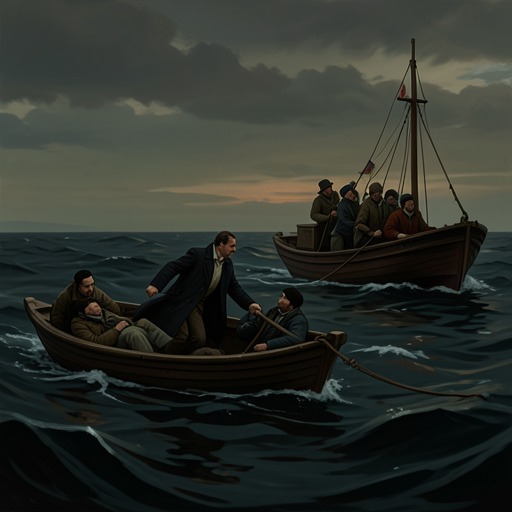
Despite the flooding, Viktor is considered towable. It has a five-degree list to starboard and is down by the stern, signs of a ship carrying uneven weight and water aft, but its report distinguishes this precarious posture from an inability to be moved. Cadena is standing by and taking Viktor in tow. The tow line is being passed satisfactorily, and Viktor estimates that another fifteen minutes will be needed before it is under way. This is a projected interval, not a confirmation that the tow has already begun moving.
Viktor retains a small measure of independent control through hand steering. Its crew says the ship can be controlled to a certain extent, a limited capability that matters even with propulsion gone: the tow does not reduce the damaged vessel to a wholly passive object. Krause orders Keeling to circle Cadena and Viktor at half a mile after sighting the rescue ship taking Viktor in tow. The instruction places Keeling close enough to remain with the recovery operation while the stricken ship and its rescuer prepare to move.
Rescue within a strained command
Viktor’s report reaches Krause after a day in which Keeling has been in contact with the enemy, and the rescue unfolds against the larger demands of convoy protection. Earlier, Krause had kept Keeling in Condition Two rather than calling all hands to battle stations continuously: the more intense posture would exhaust men, interrupt routine work, and leave the ship’s ordinary maintenance undone. He had also canceled the routine general-quarters call for that watch so the watch below could have four hours’ rest unless an emergency intervened. Keeling’s personnel were already strained by additional weapons and instruments, crowded accommodation, and too few trained ratings to provide three Condition Two watches; the ship’s company had therefore been divided into four sections on watch-and-watch rotation.
That concern for endurance gives the response to Viktor’s emergency added context. Readiness is not simply a matter of keeping every person at battle stations; it depends on preserving the capacity to act when an actual crisis arrives. Now a confirmed report, an improvised radio circuit, damage-control work, the transfer of a hundred ratings, and a tow line being prepared turn that readiness into practical support. Viktor remains flooded, powerless, and vulnerable, but the report establishes that its crew is still working, Cadena is alongside, and movement under tow is expected. The state is neither a declaration of safety nor an account of a completed rescue: it is the precarious interval in which damage has been contained enough for assistance to begin.